
BACKGROUND
In September 2023, SIBOWASCO collaborated with GoSoft Integrated Solutions to revolutionize their operations through a groundbreaking proof of concept initiative. The objective was to deploy GoSoft’s advanced ultrasonic smart digital water meters, showcasing the accurateness of these innovative solutions in the water distribution and management sector.
This proof of concept (POC) was triggered by Sibowasco’s need to visualize their water distribution network Prior to the (POC) Sibowasco could not timely assess the network. Fault we discovered after long periods and consumption information relied on human meter readings, which are prone to errors.
The initiative led to the installation of 4 meters across the broader Bondo, Yala and Siaya Town. These smart water meters seamlessly integrated into the Sibowasco water network, setting the stage for near real-time water management capabilities.
In a strategic engagement GoSoft was entrusted with the installation of 65 state-of-the-art ultrasonic smart water meters, comprising three domestic meters and one bulk smart water meter. The deployment was strategically executed, covering diverse regions to maximize the impact of this transformative technology.
Challenge One – Negative Readings
In the first month of installation, we noticed that there were inconsistent readings, including negative readings being recorded by the smart meter. After a follow-up site assessment, we concluded that these were the causes of the inconsistent readings.
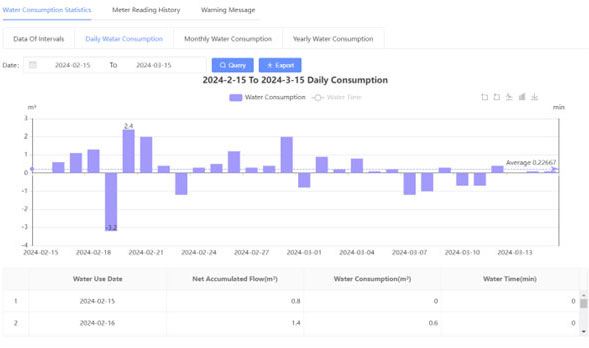
- Since the meter was installed in an already existing bio-septic system, the excavations around the tank caused the creation of a vacuum which allowed water in the surrounding area to accumulate and fill up the excavated area.
- Installing the meter on an incline. The assumption was that the meter should have a slight gradient for water flow. This incline caused there to be a backflow, and this interfered with the readings.
Solutions
On the 13th of March, in response to this challenge, the meter was re-installed and placed in a chamber that was free of water and there were no more reverse flows recorded.
The readings were consistent with our expectations as far as bio-septic systems are concerned.
Challenge Two – Flooding
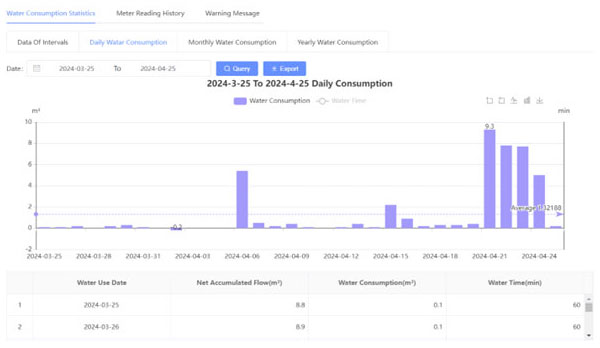
With the commencement of the rainy season in the beginning of April, we started seeing spikes in volumes of water passing through the meter. These spikes can be explained by the recent flooding that has happened especially in Kahawa Sukari where the project took place.
This is evidenced by the below picture taken by national media. The floods continue to wreak havoc in various parts of the country, and we will continue to observe the readings as the rains subside.
Lessons Learnt
Understanding the topography of an area plays a major role in the installation process. This will require detailed site assessments prior to and especially after installation.
With the bio-septic system, which relies on gravitational displacement of water, the meter needs to follow the same rules. The bio-septic applies the rule of displacement, meaning that the amount of water that enters the tank is the same amount displaced at the outlet pipe. The meter needs to apply the same principle, meaning that the meter cannot be installed directly at the outlet.
That there could be design flaws in the tank and its piping, causing seepage when the area around the tank completely floods.
Way Forward
There is a need for sanitation service providers to be involved in the decision-making process of in the placement of a sewer system in any construction. The data from this pilot project has shown us that in extreme conditions there can still be contamination of the environment despite the system being watertight.
In conclusion, as a company that deals with the installation of bio-septic tanks, we will need to discuss ways to redesign our system to account for such extremities or redesign the installation process.
We are being engaged by experts in the academic and scientific field, to assist in research around ground water contamination from septic systems. The data that collected from this project will play a pivotal role in understanding how bio-septic systems behave in all sorts of weather conditions and in all types of topographies.